
Key Points:
- NVIDIA’s $4.5 trillion valuation—another tenfold increase implying a $40 trillion valuation—larger than the entire U.S. economy.
- Competition accelerates as startups, cloud companies and other AI infrastructure players ramp up development.
- Smaller private AI startups, valued under $20 billion, offer faster growth potential and highlight the diverse tech landscape beyond NVIDIA’s current dominance.
Over the past decade, NVIDIA’s share price has soared by more than 26,000%, pushing its market capitalisation to $4.5 trillion (roughly the size of Germany’s economy, about $4.7T in 2024) and joining Microsoft as one of the world’s most valuable companies. This growth has been driven largely by the rise of AI and the company’s GPUs becoming central to data center infrastructure. In Q1 FY2026, NVIDIA reported $39.1 billion in data center revenue, up from $18.4 billion in Q4 FY24.
Yet sustaining such exponential growth at this scale faces significant hurdles. Even a 50% increase in its valuation would require an additional $2 trillion market cap. A tenfold rise would place NVIDIA at an eye-watering $45 trillion valuation – well above U.S. nominal GDP (~$29T–$31T). Such multiples become increasingly unlikely.
The Valuation Dynamic in Public Markets
A portion of NVIDIA’s increase comes from its current dominant position in major indices like the S&P 500 and Nasdaq. This means index funds, including retirement portfolios and ETFs, automatically buy shares as money flows into these funds, regardless of valuation. This creates a feedback loop of price increases driven partially by passive investment flows. As Apollo’s CEO Marc Rowan noted in 2025, “We basically have leveraged the retirement system of the country to NVIDIA.”
This dynamic can also work in reverse, any cooling in hyperscaler spending or shifts in the AI sentiment could lead to a market correction, as we have seen in November 2025.
To illustrate how valuation frameworks can differ between public and private companies, it’s useful to look at examples within AI infrastructure markets.
Private Market Alternatives and the Growth Potential They Offer
Examining private AI infrastructure companies helps illustrate differences in growth potential and valuation approaches outside the public eye. These companies range in valuation from $1 billion to $20 billion, generally smaller with room for faster growth. Even capturing a small fraction of NVIDIA’s potential revenue could yield high valuations in this segment.
There are about 498 AI unicorns with total valuations around $2.7 trillion. Many focus on AI infrastructure tailored for enterprises and governments.
A few promising start-ups to watch:
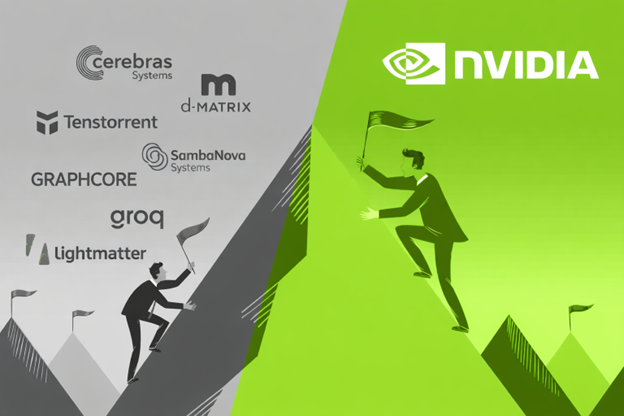
- Cerebras Systems, valued near $8 billion (Sep 2025 round), designs wafer-scale processors much larger than conventional GPUs to simplify and cut costs in training large AI models. Capturing just 1% of NVIDIA’s expected $120 billion revenue would translate to $1.2 billion in sales.
- d-Matrix, backed by Microsoft Ventures and Playground, with a valuation of $2 billion, develops low-power inference chips designed to cut costs and energy use in model deployment.
- Tenstorrent seeks to secure $800 million reaching a $3 billion valuation in a Fidelity-led round. Its investors include Samsung, Hyundai, LG Electronics, Fidelity, and Bezos Expeditions. Producing AI chips for data centres and automotive applications, it partners with BOS Semiconductors and Samsung Foundry on advanced chip designs.
AI Datacenter Chip Market Growth
The datacenter AI market is projected to grow at a compound annual growth rate (CAGR) of 31.6% and reach approximately $933.76 billion by 2030, up from about $236.44 billion in 2025. This growth is driven by rising demand for AI computational power in data centres, with the market already surpassing $100 billion in 2024.
Currently, Nvidia dominates the datacenter GPU segment, while AMD, Huawei, and a group of specialist chipmakers—including independent producers like Cerebras—hold relatively minor shares. Analysts increasingly expect custom ASICs and specialised accelerators to gain share alongside GPUs by 2030.
If independent chip producers attain a 15% share of the projected $933.76 billion market, their combined annual revenues would be approximately $140.06 billion. Applying a Price-to-Sales (P/S) multiple of 30x—similar to the revenue multiples observed for startups like Cerebras—to this revenue suggests a potential combined capitalization of approximately $4.2 trillion for hardware disruptors that may soon provide a successful challenge to established incumbents like Nvidia if they capture even a modest portion of this landscape.
By Stephen Richards Evans, Executive Chairman, Partner at Red Lions Capital
Also Read: Power Symbols: Saudi Arabia And the United Arab Emirates Leave Their mark on International Finance