
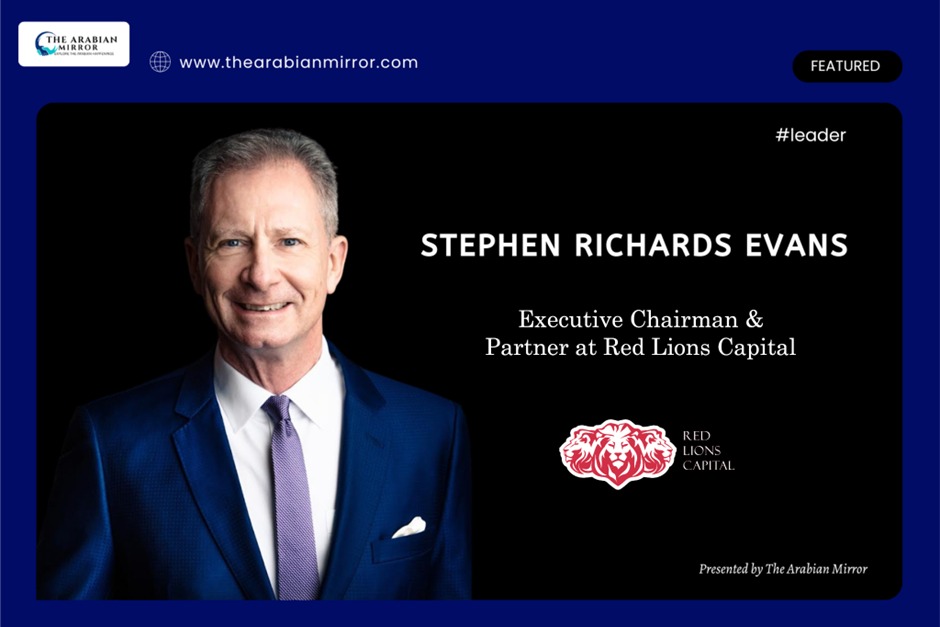
A seasoned leader in conceiving and directing global wealth and asset management platforms in four top-tier banks, Stephen Richards Evans is now the Executive Chairman and Partner at Red Lions Capital, a firm with deep expertise in VC private market research.
In 2025, total assets under management (AUM) in alternative investments have surpassed $33 trillion, reflecting robust growth as investors seek diversification beyond traditional stocks, bonds, and cash, according to J.P. Morgan Research. Alternative asset allocations are expected to approach 25% of institutional capital this year, with some forecasts projecting AUM in alternatives to reach around $30 trillion by 2035. Stephen reflects, “Private markets are booming globally. Yet most local GCC wealth management firms weren’t wired to handle private equity, private credit, or late-stage tech investments in a way that meets demand and seamless operational delivery.”
A Unique Approach
Red Lions Capital stands apart from most alternative investment firms by focusing on serving wealth managers, and family offices—rather than competing for investor relationships. Utilising AI-powered research, Red Lions Capital delivers in-depth insights on global technology unicorns and late-stage investees and recently developed an entirely new solution that empowers wealth managers to offer their thousands of UHNW / HNW clients access to a full-spectrum research of alternative assets. This approach combines the firm’s expertise in cutting-edge data analytics to continuously monitor and validate market trends, news, and emerging private market investments, enabling institutional clients to make informed decisions and expand their alternative investment offerings effectively.
Stephen explains, “We are now developing a portal that can plug directly into existing wealth management systems, so banks can offer securitised alternative investments without building new costly infrastructure. Two things set us apart. First, we’re bank-centric through enhancing their product shelf with alternatives. Second, while banks are flooded with deals, filtering quality is still manual and relationship driven. We solve this with an AI-powered scoring system that reviews both hard numbers (IRR, AUM, fees) and soft signals (news, hiring, patents, fundraising, management and sustainable strategic differentiation) to select favoured firms and provide extensive and actionable research on them.”
Empowering the Financial Institutions of the GCC
Sharing the main benefit of GCC banks and asset managers partnering with Red Lions Capital, Stephen says:
“For banks, it comes down to three things: retention, revenue, and readiness. Retention: Clients no longer have to look outside the bank for alternatives. That means assets stay in-house. Revenue: Alternatives through Red Lions Capital offer a significant multiple to banks of the total revenues they routinely book of 0.5–1% on traditional mutual funds. Readiness: Our solution integrates with existing systems, so a bank can start offering alternatives in a matter of weeks.”
The solution has already proven its worth in multiple markets, with the Gulf as its next growth engine. In live tests with banks in the UAE, Qatar, and Oman. “The feedback has been consistent,” Stephen adds. “Institutions can meet client demand for alternatives without the operational burden of building an in-house solution from scratch.”
Trends among the GCC Investors
Stephen notes two parallel shifts among GCC investors, particularly younger, tech-savvy clients. He observes that younger high-net-worth investors are far more open to alternatives than previous generations. Many follow global tech and private markets closely and increasingly look to local institutions to provide access to the kind of opportunities they see in the U.S. or Europe. A big part of this interest is in private, late-stage tech companies. It’s an asset class that’s both dynamic and exciting, with some of the world’s most innovative companies in the mix.
Second, there’s a strong digital-first expectation. Stephen believes this generation is comfortable with digital, dashboards, and instant access to information — but they still want trust and security. He mentions, “Combine that with the region’s demographic profile — over 40% of Emiratis are under 35 — and you have a market primed for alternatives, provided they’re delivered in a compliant, transparent, and user-friendly way. That’s exactly where our model fits: giving banks the solution to meet this demand.”
Looking Ahead
Stephen sees GCC private markets segment business moving rapidly toward the mainstream. In the coming years, private markets will become a standard part of tier-1 bank and other investment managers’ wealth offerings — available to a much broader investor base. He also points to the rise of integrated distribution, where alternatives will sit alongside traditional public market products on bank product shelves, with the same transparency and compliance.
“Once we execute on our vision, when someone in the GCC wants exposure to a billion-dollar private AI startup or a high-performing private credit fund anywhere on the globe, their first stop will be our partner local banks and asset management firms,” Stephen says.
Follow Stephen Richards Evans on LinkedIn
Also Read :-
Gareth Hazelden: From Fitness To Business Success
The Journey Of Dr. Norberto Santana Rodríguez