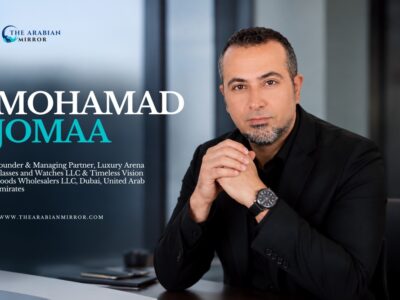

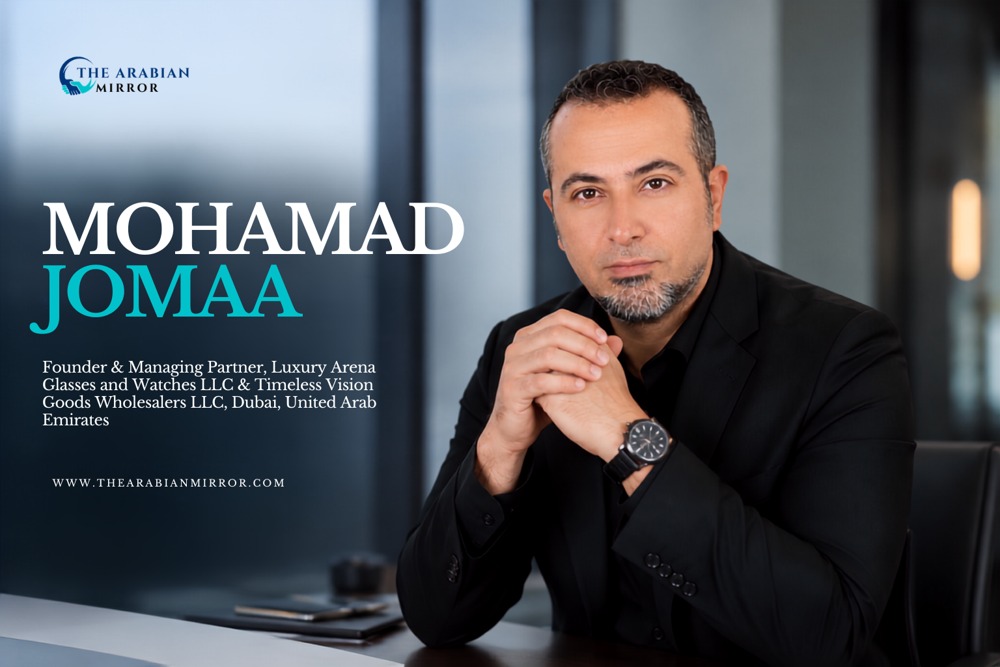
Mouhamad Jomaa is a Dubai-based entrepreneur with more than twenty years of leadership in luxury retail and distribution across the GCC, and the founder of luxury ventures in eyewear and watches.
The GCC luxury market has changed significantly over the past two decades, with new consumer habits, growing regional brands, and expanding opportunities across retail and distribution. Mohamad Jomaa has experienced this shift firsthand through his work in luxury retail, eyewear, and watches.
As the Founder and Managing Partner of Luxury Arena Glasses and Watches LLC and Timeless Vision Goods Wholesalers LLC, Jomaa shares his perspective on the region’s changing business environment, the future of luxury retail, building international partnerships, and the opportunities he sees across the Middle East.
A Region Creating Its Own Opportunities
We began the conversation by asking Jomaa what makes the Middle East an exciting place for business and investment today.
“Let’s start big. What makes the Middle East an exciting region for business and investment today?”
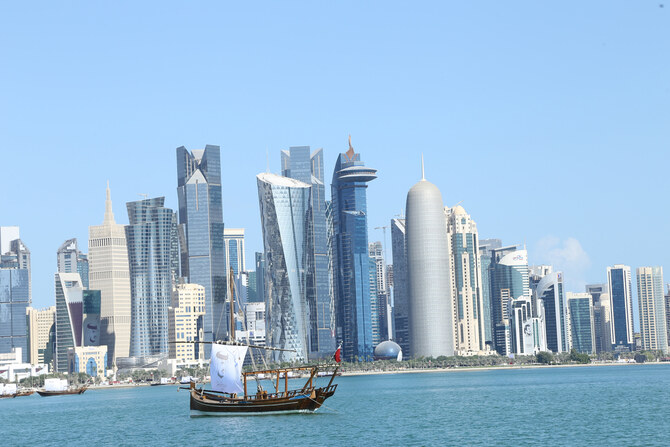
Jomaa explained, “For me, the answer is personal, because I’ve lived it for over twenty years. When I started in luxury retail, this was a region that imported everything, brands, talent, even ideas. Today, it’s a region that creates. You have stable, pro-business governments competing to make it easier to set up and own a company outright, world-class infrastructure connecting East and West, and a young, ambitious, wealthy population that loves quality and experiences. Dubai in particular has become a launchpad, you can build a brand here and reach three continents from one office. And now Saudi Arabia is opening at a scale we’ve never seen before. When an entrepreneur like me can start a company in the morning and be negotiating with manufacturers in Italy in the afternoon, that is excitement, and opportunity.”
Two Decades of Change
Having spent more than twenty years in the GCC, Jomaa has witnessed major changes in the way businesses operate across the region.
“You’ve spent two decades in this market. How has the business environment in the GCC evolved during your career?”
He shared, “Completely, and I like to say my own journey mirrors the market’s. I built my foundation at Paris Gallery Group, starting from finance, operations and logistics, and I saw the golden age of the mall culture take shape. Then came three big shifts. First, e-commerce, suddenly luxury wasn’t only about a location in a premium mall, it was about being everywhere the customer is. Second, professionalism, ERP systems, data-driven buying, open-to-buy discipline; gut feeling alone no longer survives. When I led the GCC expansion for the Chillbeans eyewear franchise, we were implementing those systems to scale smartly. And third, the rise of Saudi Arabia and the confidence of the region itself. The biggest change? Twenty years ago we asked, “Which international brand can we bring in?” Today I ask, “Which brand can we build here?””
The Future of Luxury and Retail
We then turned to the trends shaping the luxury and retail sectors, particularly in eyewear and other luxury goods.
“Speaking of building brands, what trends do you believe will shape the region’s luxury and retail sectors in the coming years?”
Jomaa stated, “I’ll speak from my own world, eyewear and luxury goods, because I saw this transformation from the inside. First, eyewear has completed its journey from a medical device to a fashion statement, people today own collections, not prescriptions, and that changes everything about how you retail it. Second, omnichannel is no longer optional; the customer discovers online but falls in love in-store, so your physical space has to be an experience, not a shelf. Third, personalization and exclusivity, the regional customer is very sophisticated and wants something that feels theirs, whether it’s limited editions or curated corporate gifting. Fourth, the Saudi consumer, young, digitally native, globally aware, will redefine what luxury means in this region. And finally, data. The retailers who will win are those who treat buying inventory as an investment decision, not an art. We launched Aigner Eyewear in this market only a few months ago, and the early response has confirmed exactly that, the appetite is there, but keeping the launch on track comes down to discipline, not luck.”
Staying Close to the Customer
We asked Jomaa how his companies maintain their position in a market that continues to change.
“And how does your company stay competitive in such a dynamic market?”
He replied, “By staying founder-led and close to the customer. I own the P&L of every venture I run, and that means decisions happen in hours, not committee meetings. At Luxury Arena Glasses and Watches, and at Timeless Vision as our distribution platform, we built three things. One: exclusive partnerships, we work directly with international luxury manufacturers, including the Italian houses behind our frames, and we recently brought Aigner Eyewear to this region. When your suppliers are partners and not vendors, you get priority, exclusivity, and better margins. Two: multi-channel strength, premium retail, corporate gifting, institutional and B2B channels. One channel may slow down; three channels rarely do. Three: operational discipline, working capital, inventory optimization, pricing strategy. In luxury, the brand image gets the attention, but the back office wins the war. And the newest proof of this strategy is one I’m truly proud of: Timeless Vision has just signed an exclusive agreement with Franck Muller, the celebrated Swiss watchmaker, to design and produce their first-ever eyewear collection. A Maison of that caliber choosing a Dubai-based company as its partner for its debut into eyewear says a lot about where this region stands today. And we never stop learning, this very month I’m in Paris for the SILMO fair, meeting manufacturers, because in this market your next competitive edge is always one relationship away.”
Opportunities Across the Middle East
For the final substantive question, we asked Jomaa where he sees opportunities for businesses over the next decade.
“My last question, a broad one. What opportunities should businesses explore in the Middle East over the next decade?”
Jomaa answered, “Five, from where I stand. First, Saudi Arabia, the entertainment and giga-projects are creating retail destinations the size of small cities; whoever builds distribution relationships now will harvest for a decade. Second, brand creation and brand extension from within the region, we are living it right now: Timeless Vision is designing and producing the first Franck Muller eyewear collection under an exclusive agreement, and our recent Aigner Eyewear launch showed how a global name can find a strong new home in this market. The next decade belongs to regionally-led brands. Third, the corporate and institutional channel, gifting, hospitality, aviation, government, it is one of the most underrated luxury markets in the Gulf. Fourth, digital and social commerce for luxury, the region’s customers live on their phones, and trust in buying premium goods online keeps growing. And fifth, Dubai as a re-export hub, serving Africa and South Asia from here is a business model in itself. But my honest advice to any investor is this: the Middle East rewards relationships and patience. Come with a ten-year mindset, partner with people who know the terrain, and this region will repay you like nowhere else on earth.”
A Final Exchange
We closed the conversation with a brief thank-you to Jomaa.
“Mohamad Jomaa, thank you.”
He replied, “Thank you, it’s been a pleasure.”
For queries: Mohammed.Jumaa@hotmail.com | +971 55 861 1322
Connect with Mohamad Jomaa on LinkedIn
Also Read:-
Leading Business Clarity Beyond Numbers: Samer Bannun
Didin Nasirudin | Bringing Strategy & Communication Into A Broader Business Perspective