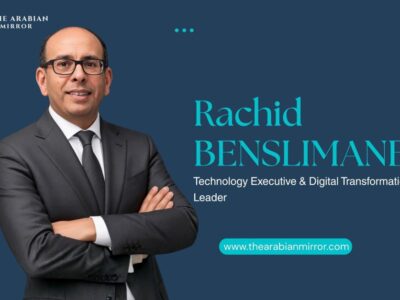

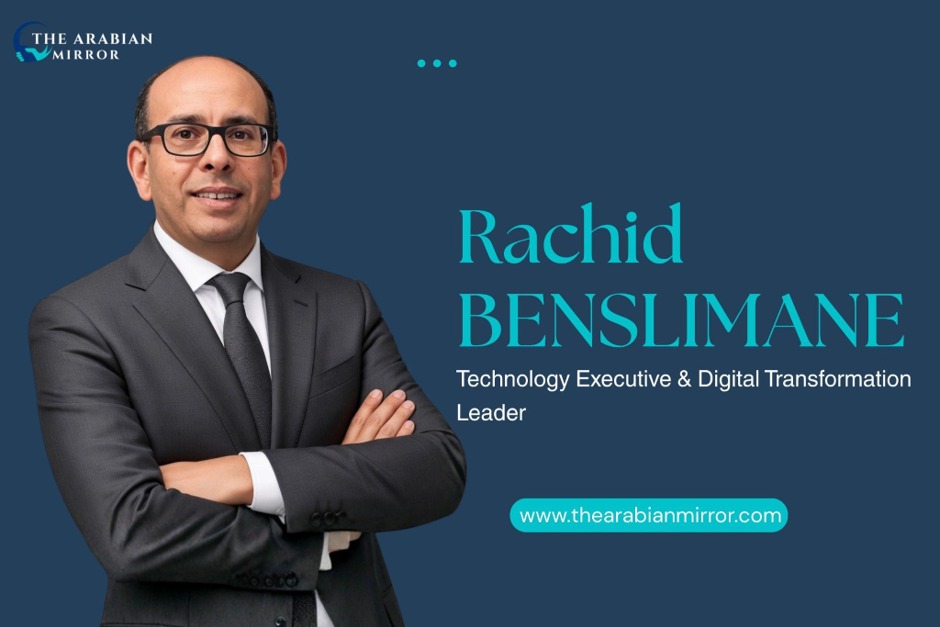
With nearly three decades of experience at the intersection of business and technology, Rachid Benslimane is a business transformation leader who has consistently made IT a driver of growth rather than a support function. His career spans entrepreneurship, business development, regional general management, and executive IT leadership across Morocco, France, and West Africa.
Most notably, he spent eighteen years building the technology function of a nationwide retail network from the ground up, turning it into a digital backbone connecting more than 1,000 stores, while also serving as a member of the company’s Board of Directors.
Throughout his career, he has led enterprise-wide transformation programs, combining an owner’s mindset with deep technological expertise to deliver measurable business value.
Vision that Sparked the Journey
Rachid’s career began with entrepreneurship rather than a conventional corporate path.
In 1997, during his final year of business school, he co-founded a software development company, DevWorks, with two classmates. Even with no external funding or established brand, and very little margin for error, they did everything from scratch from winning clients themselves and delivering software on schedule to making payroll every month. Though it was a demanding introduction to business, it was an invaluable one for Rachid’s career. He states, “When you are responsible for both creating the product and ensuring the company survives commercially, you learn very quickly that execution, cash flow, and customer trust matter as much as the technology itself.”
That entrepreneurial experience shaped the next stage of Rachid’s career. Subsequently, he joined a Paris-based IT and industrial investment firm in a business development role, where he helped structure its Moroccan subsidiary, a company specializing in web integration, enterprise portals, and IT consulting, at a time when very few in Morocco had dared to venture into these blue oceans. He adds, “I was recruiting the first consultants, negotiating distribution agreements with major technology companies, and then, almost by accident, ended up running our push into West Africa (Togo, Benin, Senegal) working with public institutions seeking to modernize their operations and infrastructure.”
In 2001, he took charge of business development at ISOFRANCE, now known as CECI, the country’s leading manufacturer of refrigerated units and utility vehicle bodies. Later, Rachid moved into a Regional Director position with GSI Maroc, where he had the opportunity to launch two new branches, in Agadir and later in Marrakech, and effectively ran them with the discipline of independent businesses, including direct operational and P&L responsibility.
Eventually, in 2008, he joined the founding team behind what would become one of Morocco’s largest hard-discount retail networks: BIM Morocco. “My mandate was to build the technology function from scratch. There was no inherited infrastructure, no IT team, and not even a single network connection. We began with a blank page. Over the following eighteen years, that initial technology platform evolved into a nationwide digital backbone supporting and connecting more than 1000 stores,” Rachid shares.
Evolution of BIM Morocco over the Years
Rachid did not simply observe BIM Morocco grow; rather, he grew with it, store by store and crisis by crisis. In the early years, the priorities were fundamental: installing infrastructure, connecting POS terminals, and building the systems required to operate an expanding retail network reliably.
As the business grew, the technology organization became progressively more sophisticated. What began with transactional systems and physical infrastructure evolved into real-time data processing, agile supply chains, and digital payment capabilities integrated into the customer experience.
He comments, “The larger transformation, however, was in the way I came to think about the role of technology itself. Working within a Turkish-led organization proved to be a business education in its own right. Decisions were made quickly. Cost discipline was deeply embedded in the culture. Hierarchy and a strong execution mentality existed side by side.
That environment taught me to evaluate technology investment from an owner’s perspective. When you are responsible for the economics of a business, every dollar invested in IT has to answer a fairly simple question: what does this actually return?”
That discipline fundamentally changed Rachid’s approach, as he stopped thinking of technology as a function operating alongside the business and increasingly saw it as part of the operating model itself. Over time, he became less a technologist managing systems and more an operator who happened to speak technology fluently.
Building Beyond Supply Chains
Hard-discount retail may not be perceived as glamorous, but its economic purpose is very tangible. At its core, it is about allowing families to fill their baskets without emptying their wallets.
Operational efficiency therefore has a direct social dimension. Every process his team automated and every minute removed from the supply chain contributed to a structure capable of delivering lower prices on real shelves to real customers. Much of that work remains invisible to the person shopping in the store. But the effect is felt at the checkout. That is an impact Rachid takes considerable pride in.
He states, “My contribution has also extended well beyond retail. During my regional leadership years at GSI Maroc, I trained teams and advised public institutions across Morocco on modernization. Earlier in my career, while working from Paris and across West Africa, I worked with governments and companies as they developed their digital infrastructure.
Those experiences shaped my view of Morocco’s broader regional role. I have always believed Morocco can act as a bridge between different markets and different pools of expertise, bringing know-how from north to south, but doing so in a way that ultimately becomes local, sustainable, and owned by the people and institutions that use it.”
What Defines Success
Reflecting on three qualities that Rachid believes are critical for success in his industry, he shares, “Integrity comes first. I once read a line that stayed with me: talent and drive without character are simply a faster way to fail.
Technology leaders today sit at the intersection of some of a company’s most sensitive responsibilities. They have access to critical data, negotiate million-dollar contracts, and oversee systems on which entire operations depend. In that environment, trust is the one currency that does not devalue.”
The second quality is the ability to think like an owner rather than simply as an employee. In his years of managing the P&L of two regional businesses, Rachid realized that every system, every server, and every contract has to justify its place economically. That lesson remained with him even as the organizations became larger and the technology more complex.
And the third, from Rachid’s perspective, is cultural fluency. He has built teams and negotiated across French, Moroccan, West African, and Turkish business cultures. Each operates with its own rhythm, expectations, and approach to decision-making. He firmly believes leadership cannot be reduced to applying the same management style everywhere.
“The executives who succeed internationally are usually those who understand how to read the room, adapt without compromising their principles, and recognize how business is actually conducted in the environment in which they are operating,” he shares.
Adaptability Amidst Technological Shifts
Rachid believes that we are currently at an important inflection point. Having lived through several major technological shifts himself, from an era in which stores relied on dial-up connections, to real-time operations, and now to the age of artificial intelligence, he highlights that AI has genuine potential to reshape the way companies forecast demand, determine pricing, and serve their customers.
“But experience has also made me cautious about the way organizations approach new technology. Technology can only deliver what the underlying foundations allow it to deliver,” he adds, “I have seen too many organizations become absorbed by the latest algorithm while their data remains fragmented across disconnected systems.”
The companies that perform best over the next decade will not necessarily be those with the most visible AI pilot. They will be those that have done the less glamorous work properly: building clean data environments, integrating their systems, and treating cybersecurity as a strategic priority rather than a technical afterthought.
Rachid states, “That last point is becoming increasingly important. As stores, payment terminals, warehouses, and corporate systems become part of one connected operating environment, the opportunities for efficiency increase substantially. So does the risk.”
Message to Beginners
Addressing professionals who face challenges similar to those Rachid encountered while establishing himself in the industry, he states, “I would begin with one principle: understand the business before you fall in love with the technology. Long before I managed an IT department, I worked in sales and business development. Looking back, that remains some of the most valuable training I have received because it taught me to understand revenue, customers, and commercial priorities before I was responsible for technology. It taught me to speak the language of the business, not simply the language of uptime.
I would also advise people not to fear the blank page. Some of the chapters of my career I am proudest of began with almost nothing already in place. I helped establish regional offices from zero. Later, I built an entire IT department from scratch. In those situations, there was usually a mandate, a deadline, and considerable uncertainty. I eventually learned that uncertainty is often where the fastest learning occurs.”
He adds, “Finally, never stop investing in yourself. My formal studies were only the beginning. Later in my career, I returned for an Executive MBA in 2012, completed a Harvard Business School Online program in 2020, and obtained several online certifications, including from MITx, Georgia Tech, and Stanford.
I did not pursue those programs because they were formally required. I pursued them because technology changes too quickly for any executive to assume that experience alone will remain sufficient. You have to keep learning while you are operating. In that sense, much of a career in technology resembles building the plane while you are flying it, and continuing to read the manual along the way.”
True to that philosophy, Rachid has recently embarked on a new chapter. He has joined a national leader in end-to-end logistics, La Voie Express Group, where he leads the company’s IT digital transformation in an industry that is new to him.
“After many years in retail, I wanted to step outside my comfort zone once again. Transport and logistics is a world with its own professions, constraints, and rhythms, and I have a great deal to learn. That is precisely what motivates me. The foundations remain the same: understand the business first, build solid systems, and put technology at the service of operations. Retail taught me how goods reach the shelf; logistics will teach me everything that happens before they get there.
Three decades in, I still feel like a beginner, and I see that as a privilege.”
Connect with Moulay Rachid Benslimane on LinkedIn to gain industry insights.
Also Read:-
Nücode AI: Shaping The Next Era Of Luxury Real Estate
Building Luxury Brands In A Changing GCC: The Vision Of Mohamad Jomaa