
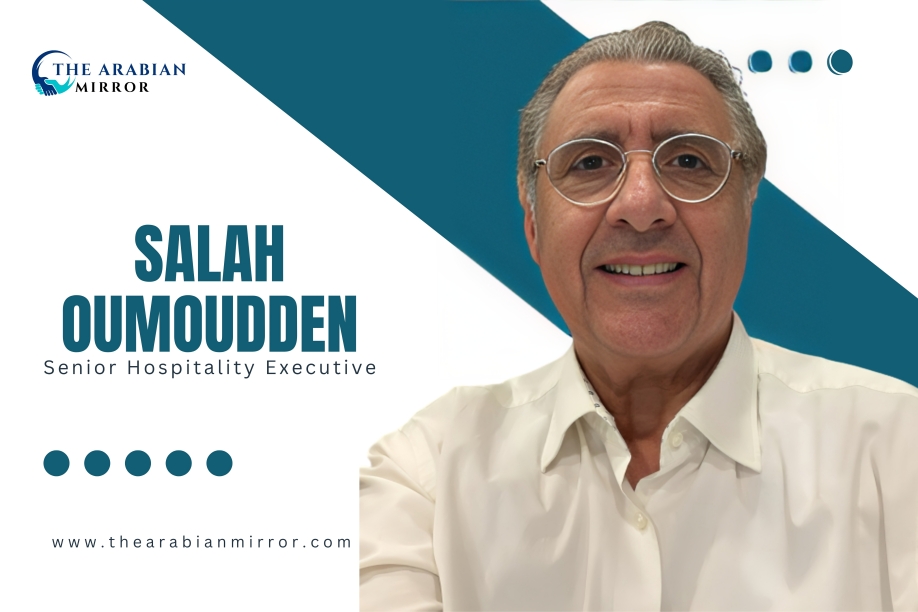
A senior Hospitality Executive and Co-Founder of Africa First for Hotels Management & Development, as well as Wejhat Hospitality Management Africa (WHMA), Salah Oumoudden is a notable figure in the hospitality industry. As a pioneering force in this industry, he also played an instrumental role in the creation of DIXIL, an innovative concept in the lifestyle hotel brands. With decades of hands-on experience, Salah Oumoudden’s strategic vision and relentless efforts are transforming the industry.
The Beginning
Salah Oumoudden’s journey into hospitality was never the result of a pre-set career plan; it grew out of a deep attraction to people, service, and the energy of places where life happens. With a strong curiosity about the world from a very young age, hospitality became his unique field of expression, one that is at once human, operational, and international. Apart from a strong academic background, Salah Oumoudden realized his true calling when he joined the field.
In 1985, together with two friends, Salah Oumoudden opened a fine-dining restaurant in Paris, and those 4 years exposed him to the daily reality of running a business, instilling in him the values of discipline and responsibility. He reflects, “They later led me to join Ibis Paris La Défense in 1989 as Food and Beverage Director. Very quickly, I understood that hospitality is not only about assets or procedures; it is first and foremost about leadership, culture, and human connection.”
Three milestones shaped the executive he is today. His first appointment as General Manager in 1995 taught him to combine operational rigor with team empowerment. The second was his role as Vice President of Operations for Ibis and Mercure, where he helped develop 14 hotels and led teams to ISO 9001:2000 certification, embracing a defining lesson that excellence is always the product of a system.
“The third was my entrepreneurial chapter: co-founding Africa First in 2021, followed by WHMA in 2025. With Africa First, we created DIXIL and proved our ability to design, develop, and open a new-generation lifestyle hotel; with WHMA, we took a further step by building a platform capable of connecting African ambition with international reach,” Salah Oumoudden adds.
Evolution of the Companies over the Years
Africa First for Hotels was founded in February 2021 with a clear ambition: to bring a new generation of lifestyle hospitality concepts to emerging African markets, designed for their realities rather than imported through standardized formats. Salah Oumoudden and his partners wanted to build an offer that was locally rooted, compelling for modern travelers, and credible for investors.
Salah Oumoudden mentions, “In just over a year, Africa First moved from concept to execution. We created the DIXIL brand from scratch, negotiated a management agreement with a Moroccan investment group, supervised the entire development and construction cycle, and opened DIXIL Garden Tangier in June 2022, a 170-room lifestyle property that immediately found its market with both local and international guests. Since then, our growth has expanded in both depth and reach. Our pipeline includes projects in Dakhla, Kenitra, and Rabat.”
The creation of Wejhat Hospitality Management Africa (WHMA) in 2025 marked a major strategic acceleration for Salah Oumoudden . Backed by Best Western, an international platform of more than 4,500 hotels in 100 countries, WHMA was entrusted with the exclusive representation of the group in North Africa, with a priority development focus on Morocco. That step changed the organization’s positioning, making it no longer only a brand creator and asset developer; it has become a hospitality platform able to combine brand creation, management, investor advisory, and a bridge to international standards.
Contribution to the Regional Ecosystem
Africa First and WHMA contribute to the regional ecosystem in complementary ways. On one side, Africa First develops hospitality concepts that are rooted in local needs, by investing in markets that have historically been less served by major international brands, such as Tangier, Dakhla, and Kenitra. This creates activity, attracts both business and leisure travelers, and strengthens the appeal of fast-growing territories.
On the other side, WHMA brings a more structured dimension. By representing an international group in North Africa, with a priority focus on Morocco in the preparation of the co-organization of the World Cup in 2030, the brand gives owners and investors access to brands, standards, distribution tools, and global visibility that they would not always secure on their own. It is a very concrete way of connecting African markets to the international hospitality economy without losing sight of local realities.
We also contribute through human capital. Having launched the Accor Academy in Morocco, I have always believed that training is a strategic lever, not a secondary HR topic. We recruit, train, and develop talent locally. Finally, we also play a role in aligning investors and operators, with an approach designed to reduce friction in the partnership and create a healthier, clearer, and more sustainable relationship around each project.
What Defines Success in the Hospitality Industry
Bringing more than 35 years across four continents and dozens of markets, Salah Oumoudden strongly believes that success in hospitality, especially at the leadership level, rests on three non-negotiable qualities.
The first is resilience. Hospitality is one of the most volatile industries in the world. Salah Oumoudden has led operations through the aftermath of 9/11, the Arab Spring, the COVID-19 crisis, and several geopolitical disruptions across North Africa and the Middle East. The leaders who endure are the ones who absorb shocks, adapt quickly, and protect their teams through uncertainty.
The second is the ability to understand people, both guests and teams. Hospitality is a deeply human business. Salah Oumoudden even mentions, “The best professionals I have worked with were not necessarily the ones with the most sophisticated financial models; they were the ones who understood what drives their teams and what their guests truly need. In our industry, empathy is a real competitive advantage.”
The third is the discipline to build systems. Excellence is never accidental. From achieving ISO 9001 certification early in his career to implementing Balanced Scorecard transformation frameworks across multi-country operations, Salah has always believed that sustainable performance requires robust processes, clear accountability, and a culture of continuous improvement.
Adaptability to Technological Change
In the current times, technological advancements are reshaping sectors. In hospitality, technology is no longer simply a back-office efficiency lever; it has become central to guest experience, commercial performance, and execution quality. The operators who succeed are those who adopt the right tools without losing the human dimension that defines great service.
At Africa First, DIXIL Garden Tangier is designed around a digital-first operating model, with hotel management systems that provide real-time visibility on occupancy, revenue, and guest satisfaction, allowing them to manage faster, with more precision and better decision-making.
“One of the innovations I embraced early on was the use of digital learning platforms. When I launched the Accor Academy in Morocco, I saw how technology could accelerate capability building and democratize access to training. That logic remains central to the way we build teams today.
With WHMA, this approach takes on a broader dimension. Representing an international platform with an internal e-learning system for hotels, will facilitate alignment with high standards in distribution, reporting, reservations, and owner support. Technology, therefore, becomes not only an operating tool, but also a factor of credibility and scalability,” Salah shares.
Navigating through Challenges
Addressing the aspiring professionals in the field of hospitality, Salah shares, “My first piece of advice is to start from the ground up and stay humble. I began in food and beverage before moving through every level of hotel operations and eventually into general management. That detailed understanding of how a hotel truly works, from the kitchen to the front desk to the P&L, has been my greatest asset in every leadership role I have held. You cannot lead what you do not understand.
Second, look for difficult assignments, not comfortable ones. The moments that accelerated my career the most were turnaround situations: taking Accor’s Saudi subsidiary from near-bankruptcy to profitability, achieving the first dividend in Egypt after fifteen years, and restructuring operations across several markets at once. Adversity builds judgment, and judgment is what separates good managers from great leaders.
Third, invest in relationships as seriously as you invest in performance. Hospitality is, at every level, a relationship business: with guests, owners, partners, and teams. My ability to build trust across cultures, languages, and business contexts has opened more doors for me than any diploma ever could.
Finally, learn how to connect local vision with international credibility. One of the great lessons of my journey is that having a good idea is not enough; you must also make it legible and reassuring for investors, partners, and global brands. Africa First allowed us to build a differentiated offer, and WHMA gave it a broader reach. That combination, local anchoring with international standards, is what creates lasting value.”
Connect with Salah Oumoudden on LinkedIn.
Read more:
Shamzani Hussain | Shaping the Future of the Financial Industry by Innovating and Making an Impact
Dr. Sofica Bistriceanu | Bridging Medicine, Research, and Human Connection