

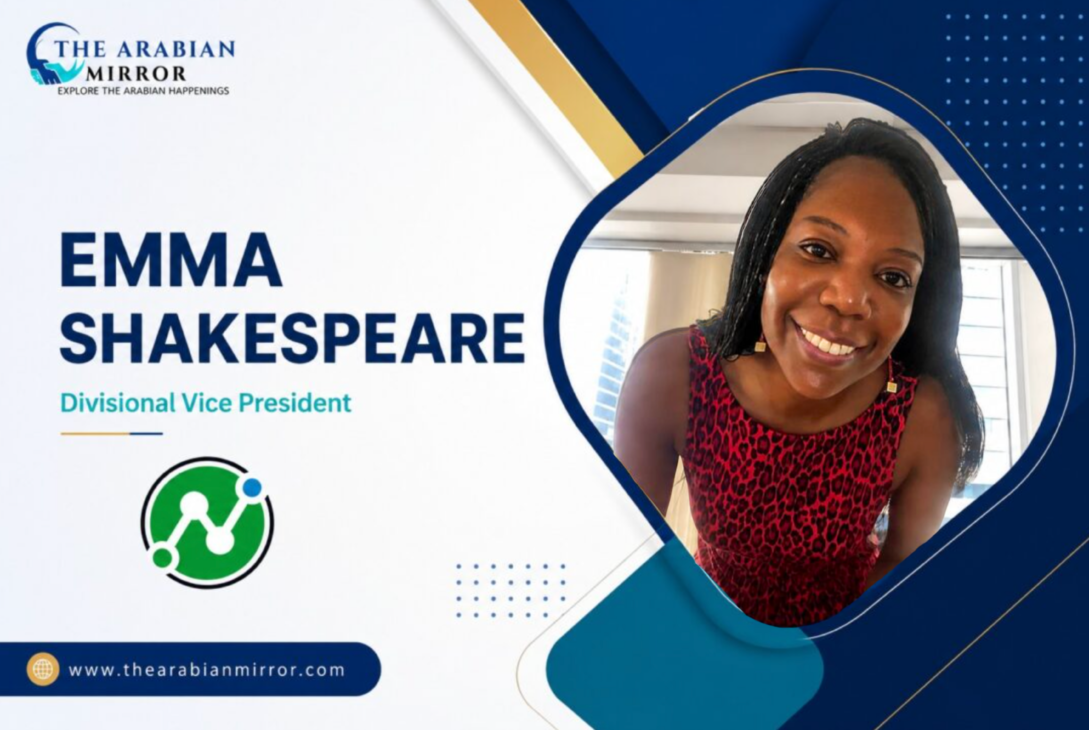
Few leaders bring the blend of enterprise software depth and sales leadership that Emma Shakespeare does. Two decades in, she has built and led high-performing teams across some of the most complex markets in the world — and her style is unmistakable: authentic, direct, and rooted in the belief that people do their best work when they feel genuinely valued. As Divisional Vice President (MEA) at insightsoftware, Emma leads growth across the Middle East and Africa, partnering with CFOs and senior stakeholders to deliver connected solutions for the Office of the CFO.
The Beginning
Growing up in the South West of England gave Emma a particular kind of grounding. “The countryside gives you space to think. Not a lot of distraction,” she says. Her parents shaped the way she sees the world. She watched them build a home in Jamaica from scratch — with clear vision and the discipline to see it through — and that became the lens through which she views everything today.
“It’s probably also why I love property and building things,” she reflects. “There’s something about the act of building — physically, financially, professionally — that traces directly back to watching them do it from scratch at 7 years old.”
On education, she’s refreshingly honest. “I’m a doer far more than I am an academic. No subject ever lit me up in a classroom the way real work does. I learn by doing, by being responsible for something, by getting it wrong and figuring it out.”
The pivotal moment came with her first management role in the UK, at Flextronics, where she felt the full weight of looking after people for the first time. Then Covid arrived, and with it the deepest leadership lesson of her career so far — the realisation that vulnerability and humanity aren’t the opposite of strong leadership; they’re the foundation of it.
“Between that, some difficult personal experiences, and frankly being managed badly myself, I pivoted as a leader,” Emma shares. “I’m a much better leader now because of it. I genuinely believe my job is to make people feel valued — not in a soft way, but in a serious way. People do their best work when they feel seen, and when they know you believe in them.”
Today, she leads insightsoftware’s growth across the Middle East and Africa — two vast, complex, very different regions. Africa in particular has an IT infrastructure landscape that demands a completely different approach to the Middle East. “That’s the part of the job I love,” she says. “No two days look the same.”
The Evolution of insightsoftware
The story of insightsoftware is one of the most remarkable growth stories in enterprise software — and Emma is quick to credit those who built it long before she arrived. The company was formed in 2018 through the merger of Global Software and Hubble, but the lineage and expertise behind it run far deeper.
“Within the first year, we’d already added Wands, CXO Software, BizNet and Jet Global Data Technologies,” she explains. “Headcount went from a few hundred to over 450 by 2019. Today, we’re more than 2,000 people globally, operating across more than 25 offices, serving over 32,000 organisations and more than 500,000 users. That tells you we’ve grown consistently and aggressively — both organically and through close to 30 acquisitions.”
“I can’t share specific revenue numbers beyond what’s public, but the trajectory has been year-on-year growth. We’re considered a hyper-growth company in the enterprise software space, and that isn’t marketing — it’s reflected in our hiring pace and the breadth of our portfolio for the Office of the CFO.”
Driving Transformation with insightsoftware
The Middle East and Africa are, in Emma’s words, “some of the most exciting markets in the world right now — and a lot of the world hasn’t quite caught up to that yet.”
“If you look at the published strategies across our region, the consistency is striking. Saudi Arabia’s Vision 2030 is reshaping the Kingdom across every key sector, with data and AI explicitly positioned as the new engine of the economy. The UAE’s National Strategy for Artificial Intelligence 2031 aims to make the UAE one of the leading nations in AI, with an integrated smart digital system underpinning government performance.”
“Dubai became the first paperless government in the world by the end of 2021 — eliminating over 336 million paper transactions and saving more than 1.3 billion sheets of paper. That achievement set the bar for what a digital government can look like. And across Africa, the African Union’s Digital Transformation Strategy 2020–2030 is doing similar work at a continental scale, transforming societies, economies and generating real growth.”
And this, she says, is the part that genuinely excites her. “None of these strategies succeed without modernising how finance and data work inside organisations. You cannot build an AI-powered economy on top of manual financial reporting, disconnected spreadsheets, or processes that take weeks to close the books. The ambition simply doesn’t survive contact with that kind of operational drag. And that’s exactly where insightsoftware contributes.”
“insightsoftware is a global provider of connected solutions for the Office of the CFO. We automate financial reporting, planning, accounting and disclosure across more than 140 ERP systems, and we make trusted financial data accessible, fast and AI-ready.”
“So when a Saudi enterprise aligns with Vision 2030’s digital economy goals, or a UAE organisation feeds clean data into the AI-driven services the 2031 strategy envisions, or an African business participates in the continent’s digital single market — what we do sits quietly underneath all of it. We’re the layer that makes the bigger ambition possible. Governments in our region are publishing some of the most ambitious digital strategies anywhere in the world. Our job is to make sure the finance function inside every business is ready to run at the pace those strategies demand.”
What Defines Success in Enterprise Software
After two decades at the intersection of enterprise software and emerging markets, Emma is clear on what separates the leaders who succeed from the ones who don’t.
Cultural curiosity. Not the corporate-speak version of “understanding different markets,” but the genuine humility to recognise that what works in London or Raleigh will not necessarily work in Lagos, Riyadh or Nairobi. “In my world, this is non-negotiable,” she says. “The leaders who succeed in the Middle East and Africa are the ones who arrive curious and humble — not certain.”
Discipline. Enterprise software is a long game. Deals take time, relationships take longer, and growth compounds quietly. “The people who win in this industry aren’t the ones with the flashiest quarter,” Emma says. “They’re the ones who do the unglamorous work consistently — with a real strategy for the long-term wins.”
People-first leadership. “This is a people business. Making your team feel valued isn’t soft — it’s the entire job. In a hyper-growth company moving fast across regions, with tools and processes constantly evolving, the leaders who hold teams together are the ones who lead with empathy and clarity, not just targets. People first leadership is the most important.”
Embracing Technological Advancements at insightsoftware
Emma sees the last five years of enterprise software as split almost cleanly into two eras: before AI, and after.
“Companies in our space had to make a real decision — bolt AI on as a marketing layer, or build it properly into the product in a way that actually changes the day-to-day work of the people using it. insightsoftware took the harder path, and I’m glad we did.”
The innovation she points to is Lineos, the AI powered by insightsoftware, built specifically for the Office of the CFO. “What makes Lineos matter is that it isn’t a generic AI assistant dressed up for finance. It’s purpose-built embedded into the insightsoftware Platform, which standardises financial, business and operational data across our products — so it actually understands the work.”
“Finance teams are using it to accelerate variance investigation, give same-day responses when executives ask the difficult questions, and build polished board reports without spending hours on formatting. The shift is from finance professionals doing routine data work to finance professionals shaping strategy — and that is a meaningful change in what the job actually looks like.”
Insights from an Expert
Asked what she’d say to those starting out — particularly women stepping into a male-dominated industry — Emma doesn’t hesitate.
“Working in a male-dominated industry can be tough. Early on, I caught myself preparing twice as hard for meetings, qualifying my opinions more than my male peers did, softening things that didn’t need softening. My advice, looking back, is simple: don’t shrink to fit the room. Take up the space. Credibility comes from your work and your judgement — and the sooner you trust that, the sooner everyone else does too.”
To anyone stepping into leadership, she offers this: “Notice the management you didn’t like being on the receiving end of, and consciously do the opposite. People can tell the difference between a leader who is performing care and one who is actually paying attention. The job isn’t to have all the answers. The job is to make people feel valued enough to do their best work.”
And to anyone trying to bring a Western playbook into the Middle East or Africa: “Don’t. The infrastructure is different, the buying cycles are different, the relationship economy is different — and Africa in particular requires a completely different methodology. Arrive curious, not certain. The leaders who succeed in this region are the ones who listen first, build relationships before pipelines, and respect that the people who already live and work there know more than you do. Humility isn’t a weakness in international business — it’s the most strategic posture you can take.”
Connect with Emma Shakespeare on LinkedIn for industry insights.
Find insightsoftware on LinkedIn and visit the website to learn more.
Also Read :-
Salah Oumoudden: Shaping Africa’s Hospitality Landscape with Vision and Innovation









[…] Emma Shakespeare On The Future Of Enterprise Software […]
[…] Emma Shakespeare On The Future Of Enterprise Software […]
[…] Emma Shakespeare On The Future Of Enterprise Software […]